
Showing posts with label Solemn Mass. Show all posts
Showing posts with label Solemn Mass. Show all posts
Wednesday, December 18, 2019


Wednesday, August 21, 2019
The Holy Sacrifice of the Mass

Introduction
to "The Sacred Ceremonies of Low Mass"
By
Rev. Felix Zualdi, CM
The
august Sacrifice of the Mass comprises in itself all that is most sublime and
sacred in our Holy Religion. All the sacrifices of the Old Testament were only
shadows of that of the new, which, as St. Leo says, really offers to God what
the Jewish sacrifices only promised. The offering should bear some proportion
to the person to whom it is made; but since the ancient sacrifices were only
weak and needy elements, they could in no way satisfy for man’s debts to God
and hence another sacrifice was required. The old victims were insufficient,
the Levitical priesthood was impotent in the sight of God, therefore it was
necessary, as the Fathers of the Council of Trent express it, that by the
ordination of God the Father of Mercies, another Priest, according to the order
of Melchisedech, our Lord Jesus Christ, should arise, who would consummate and
bring to perfection all who were to be sanctified. Although Our Lord fully
consummated the sacrifice by offering Himself to God the Father, and by dying
on the altar of the Cross for our redemption yet His priesthood was not to
expire with His death, but was to continue visible in His Church to the end of
ages, as He Himself promised at His Last Supper when, instituting the
Eucharistic Sacrifice, He gave the same Divine authority to the Apostles and to
their successors. Every Priest can, therefore, say to himself when ascending the
altar: I am no longer a mere man of clay, a weak creature—being identified with
Jesus Christ through the power and the infinite value of the Victim I am about
to offer. With what a high degree of virtue ought such a dignity be
accompanied!
There
are four kinds of worship given to God in the Sacrifice of the Mass. The first
is called Latreutic, which is due to Him and can be given to His Infinite
Majesty alone, and which is rendered by the Sacred Victim along with the
adoration of the faithful, of the Saints, and of the Angelic Hosts, who,
according to the opinion of the Fathers, reverently surround the altar. The
second form of worship is termed Eucharistic, by which man raises his
voice in perfect thanksgiving to his most generous Benefactor. In it, the
excess of the Divine Goodness invests us with the power of offering abundant
satisfaction to Him; and the greatest advantage we derive from this benefit is,
that we can thereby make an adequate return for what we have received from God.
God delivers us from the abyss; we present to Him the Deliverer. He opens
Heaven to us; we offer to Him the Heir. So much does the supreme goodness shine
forth in the Holy Sacrifice of the Mass, that not only is our act of
thanksgiving in keeping with the great benefits conferred upon us, but forms a
return in some way suitable for the great love manifested in His conferring them
upon us. We do this not merely once, as St. Gregory Nazianzen remarks, as when
our Blessed Lord offered Himself in the Incarnation to His Eternal Father, but
a thousand times, when we offer that Divine Son in the Mass, impassible and
glorious as a worthy victim of thanksgiving.
The third act of worship
is Propitiatory—to appease
the anger of God, to satisfy the demands of His justice, and to obtain the
pardon of our sins. Man should appease the Lord to whom he has been ungrateful,
and avert His anger lest he might be cast off forever. All other creatures
cried for vengeance against sinful man: Jesus Christ appeared and immolated
Himself upon the Cross; peace came upon the world, man’s sins notwithstanding,
and the unbloody Sacrifice of the Mass pours out on him the grace of repentance
and reconciles him with Divine justice. The Sacrifice of Calvary supplied the
treasures, that of the Mass distributes them. From the treasury, judge of the key;
and if the Passion of Jesus Christ fits us for the benefits of Redemption, the
Sacrifice of the Mass enables us to enjoy them, for St. Chrysostom says : “Tantum valet celebratio Missae quantum mors
Christi in cruce,” and the Church herself moreover assures us of it in
these words: “Quoties hujus hostiae
commemoratio celebratur, opus nostrae Redemptionis exercetur.”

But
the worship we render to God, as the Author of every good gift, is based upon
our prayers, serving as we do a Lord who wishes us to pray to Him, uniting His own
glory with our best interests. “Call upon
Me,” He says, “in the day of trouble;
I will deliver thee, and thou shalt glorify Me.” Prayer constitutes the
fourth act of worship, called Impetratory, for the due rendering of which
to God the Mass furnishes us with the best of all means of moving the Divine
liberality in our favour. We are unworthy not only to be heard but even to ask,
and consequently unworthy of receiving, from the very fact that we are obliged
to ask. The Word of God prayed for us, and “was
heard for His reverence.” In the Mass He prays to the Father continually
for us, in the same manner as He did, bathed with tears and blood, on the
Cross, and we through Him are heard. On the altar the word of Salvation is
raised, the life-giving Host is laid, and there is worked the most sublime
miracle, ravishing in ecstasy of wonder earth and heaven. The Son of God, the
invisible High Priest, the Holy Pontiff, just, innocent, separated from
sinners, higher than the heavens, and able to compassionate us in our
infirmities, intercedes for us with unutterable groanings, and becomes our propitiation,
our victim: and the Eternal Father, who promised to hear everyone invoking Him
in the name of His Son, cannot refuse the Son Himself praying, and offering
Himself for us. “O Father!” we may
suppose Him to exclaim in the Mass, “O
Father! wilt Thou not remember the sacrifice which I consummated on Calvary? Look
down on the renewal of it, that Thou mayst bestow on My brethren the graces I
gained by My death.”
Such is the excellence of
the sacrifice of our altars. Would to Heaven that all the Priests going forth
every day with joy to the mystic Calvary, animated with sublime sentiments of
religion, and covered with the blood of Our Redeemer, would present themselves
to the Father, uniting, as St. Gregory the Great remarks, by an interior and
invisible sacrifice, their groans to those of the Victim who died for men, and
showing themselves alive to their solemn office and to the wants of poor souls.
Then would they, by the Mass, honour the majesty of God, thank Him for His
benefits, appease His justice, and implore His mercy. And since of all our
functions, the Mass is the most holy and the most divine, fulfilling, as it
does, the four great
ends already mentioned, it appears very clear that no study or diligence should
be omitted by the Priest in order that such a sacrifice may be celebrated with
the greatest possible interior purity and exterior devotion, as the Council of
Trent directs, declaring that the terrible anathemas fulminated by the Prophet
against those who perform negligently the functions prescribed for divine worship
apply rigidly to the ministers who celebrate Mass with irreverence. In order
then that the Priest may avoid so great a fault, and the divine malediction
consequent on it, let us remind him in the Introduction to this work what he
ought to do before celebrating, while celebrating, and after having celebrated.
All may be reduced to these three points: 1st, Preparation; 2nd,
Reverence and Exactness; 3rd, Thanksgiving.


1. The Preparation is
remote and immediate; the remote consists in the pure and virtuous life, which
should be led by the Priest, in order that he may celebrate worthily.
Therefore, his acts, his words, his thoughts should breathe of purity, that he
may be fit to celebrate with proper dispositions. If he who handled the sacred vessels
of old should be pure, how much more so must the Priest be, who bears in his
hands and in his breast the Incarnate Word of God? This purity of life
consists, first, in preserving himself undefiled from every sin, not only
mortal, as he is necessarily bound to—but also, to secure greater purity, every
deliberate venial sin, and even from every affection to venial sin; and
secondly, it consists in applying himself most diligently and constantly to the
acquisition of every virtue. “Qui justus est, justificetur adhuc, et sanctus, sanctificetur adhuc”
(Apoc. xxii. ii). For
the immediate preparation, mental prayer is requisite. The venerable John of
Avila prescribes an hour and a half; St. Alphonsus reduces the time of
immediate preparation to half an hour, and even to a quarter; but he adds,
indeed, a quarter of an hour is too little. The Passion of Jesus Christ should
be the continual thought of the Priest. Having finished his meditation it is
meet he should recollect himself for some time before proceeding to celebrate,
and consider the great action he is about to perform. He should seriously
ponder, says St. Augustine, these four thoughts: “Cui offeratur, a quo offeratur, quid offeratur, pro quibus offeratur.”
On entering the sacristy, he should say with St. Bernard: “Worldly affections and solicitudes, wait here until I have celebrated
Mass.” The Priest should likewise consider that he is about to call from
heaven to earth the Word Incarnate, to sacrifice Him anew to the eternal Father,
to be fed with His sacred flesh; he should in fine, reflect upon his most
serious responsibility in becoming at the altar the mediator between God and
man.
2. Reverence and
Exactness.—It is necessary in celebrating, to manifest all the reverence
due to so great a sacrifice. This reverence means that due attention be paid to
the words of the Mass, and that all the ceremonies prescribed by the Rubrics be
exactly observed. As to the attention, the Priest sins by willful distractions
while saying Mass; and these willful distractions, if occurring at the
consecration of the sacred species, or during a notable portion of the Canon
are, according to a large body of theologians, mortal sins. It is not
considered possible that a Priest so acting could fulfil what is prescribed by
the Rubric in these words: “Sacerdos
maxime curare debet ut . . . distincte et apposite proferat . . . non admodum
festinanter, ut advertere possit quae legit.” Exactness regards the
fulfilment of the ceremonies enjoined by the Rubrics, in the celebration of the
Divine Sacrifice. The Bull of St. Pius V., found in the beginning of the
Missal, strictly commands that the Mass be celebrated according to the rite of
the Missal, so that no willful omission, even though it be trivial, of what is prescribed
for the actual celebration of Mass, whether in word or in action, can be
excused from the guilt of, at least, venial sin. It is commonly held this does
not apply to what we have said of the preparation for the sacrifice and
thanksgiving after it. Words half pronounced, genuflections half formed,
incomplete signs, and confused and hurried actions, may lead to grave
sacrilege. There are some who hurry over the Mass in such a way that the interrogation might be put regarding them
which Tertullian used for another purpose: “Sacrificat,
an insultat?” Of such ministers it might be said they are not Priests but
executioners, who insult the Passion of Jesus Christ; they are perfidious Jews,
who, instead of pleading for pardon, bring upon their souls everlasting malediction.
Add to this the scandal given by him who celebrates without devotion. The
people respected our Divine Saviour in the beginning of His public life, but
when they saw Him despised by the priests they lost all reverence for Him, and
cried out for His death. The greater number of authors, including Benedict
XIV., Clement IX., and other very learned Pontiffs, declare that the
celebration of the Sacrifice of the Mass should not occupy more than half an
hour, nor less than the third part of an hour. Such a space of time is
prudently considered sufficient, both to secure a due and reverent celebration and
to prevent weariness on the part of those assisting. Whoever fails herein
merits reprehension; but he who gets through the Mass in a less space of time
than a quarter of an hour is, as St. Alphonsus holds, guilty of mortal sin.


3. Fervour in Thanksgiving after Mass is a
sure proof that the Priest has offered the Sacrifice with a heart animated with
holy affections. If he has celebrated, with the fire of the love of God it will
not be easily extinguished in him. Every benefit claims its acknowledgment.
Now, let us consider what gratitude is due to God by the Priest who has been
just permitted to say Mass! “Oh! what an
abuse and what a shame,” cries out St. Alphonsus, “to behold so many Priests who, after having celebrated Holy Mass, after
having received from God the honour of offering to Him in sacrifice His own
Divine Son, and after having been fed with His most Sacred Body, with tongues
still purpled with His most Precious Blood, having hurried over some short
prayers coldly and inattentively, commence immediately to discourse of useless things
or of worldly business; or else go forth carrying about the streets Jesus
Christ, who is still reposing in their breasts under the sacramental species.”
With such might we deal, as the Venerable John of Avila once did with a Priest
who left the church immediately after having celebrated. He sent two clerics,
bearing lighted torches, to attend him, and they, when asked by the Priest what
they meant, replied: “We accompany the
Blessed Sacrament which you carry in your breast.” Alas! How sad: and yet
this is the fittest and most precious time to treat of our eternal salvation
and to gain new treasures of grace. This is the propitious hour in which we
should present to our Saviour devout offerings and thank Him for the privileges
just conferred. After Communion, as St. Teresa says, let us not lose so good an
opportunity of treating with God, since His Divine Majesty is not wont to
reward sparingly him from whom He receives a hearty welcome.
As long as the Sacramental
Species remain every act of virtue possesses greater value and merit, because
of the strict union which then exists between the soul and Jesus Christ, as He
Himself declared: “Qui manducat meam
carnem et bibit meum sanguinem, in me manet et ego in illo.” Therefore acts
performed at this time have the highest degree of efficacy and value, for, says
St. Chrysostom; “Ipsa re nos in suum
efficit corpus.” Jesus places Himself in the soul as on a throne, and He
seems to say to her, as He formerly did to the man born blind, “Quid tibi vis faciam?” . . . Would it
not then be most advisable that every Priest should entertain Himself with
Jesus Christ for half an hour after Mass, says St. Alphonsus; or even for a
quarter of an hour?
The first portion of the
time of thanksgiving should be devoted by the Priest to the recital, more with
his heart than with his lips, of the customary prayers proposed by the Church,
which are found in all Missals and Breviaries. The second part should be spent
in loving communion with Jesus, in sentiments of adoration, of thanksgiving, of
oblation, and of supplication. The Priest should pray for himself and for the
Church; he should pray for all the people in general, and in particular for
those of his own diocese, of his country ; for his relatives; for the living
and for the dead; for all the members of the Catholic Church; particularly for those under his own charge
(parishioners, penitents, etc.); he should pray for all, that all may come to
know, to love, and to serve God on earth, and so afterwards to glorify Him with
the angels and saints in Heaven.


Thursday, June 21, 2018
The Sin of Lust
LUST -- THE SLAVERY OF SIN
“The wages of sin is death.” — Rom.
6: 23.

From the beginning of the world, sin and Satan have made wretched, helpless slaves of innumerable members of the human
family. Bound in the chains of
guilt, unable to move to work out their glorious destiny, blind and deaf
to the true beauties of God’s
world and serving him whose servants they have made themselves in a hundred degrading offices; bound perhaps in the bonds of evil habits;
bound sometimes forever in the dungeon of hell, where all hope is left behind, where no order but eternal horror abides.
If
this be true, as it undoubtedly is, of all sin, it is especially true of sins
of lust. No sin among the long category which are the links
that chain men to death, binds them more firmly, is more difficult to cast off
by repentance. None becomes more strong as it is worn longer, none sinks the wretched body and soul more deep in degradation, none is a more probable cause of eternal death. No sin in the long
record of man’s crimes has left such a history of shame
and sorrow, of degradation and disgrace, of rack and ruin, of death
and probable damnation, as the sins of the flesh.
Wars have been waged,
nations been wiped from the face of the earth, schisms have arisen and heresies taken
their origin in it. Treachery in
its most revolting forms, even pestilence and other natural calamities
have been the consequences of
the indulgence of this passion. Commentators
hold, and Holy Writ seems to imply, that it was through the
lustful loves of the sons of God with the daughters of men that “all
flesh had corrupted its way” in the time of Noah. Wherefore God said: “I will destroy man whom I have created from the face
of the earth, from man even to the beasts, from the creeping
thing even to the fowls of the
air; for it repenteth me that I have made them.” The fearful punishment of the deluge was therefore a mark of God’s resentment against lust. (Gen. 6.)
The
lascivious
conduct common among the men of
Sodom and Gomorrha was the cause of the visitation of God’s
wrath in a rain of fire
and brimstone, which has left the very sites of those cities undistinguishable even to the searching eye of modern
research. (Gen. 19.) The unnatural lust of the men of Gabaa, of the tribe of Benjamin,
caused a war in which all the men
of that tribe were slain. (Judg. 20). The sons of Juda were struck
dead (Gen. 9), Joseph was cast into prison (Gen. 39), Samson was betrayed to
his enemies (Judg. 16), Ammon, the son of David, was killed (2 Kings 13), and all in consequence of unbridled
lust. David himself became guilty of adultery and
murder and brought pestilence upon a whole people, and all through an immodest
glance. Solomon departed from the service of God and prepared the way
for the division of his
people, when he loved strange women. (3 Kings II.)
Profane history teaches
the same lesson. The sinful
desires of Paris brought about the Trojan war and the destruction
of “proud
Ilium.” Those of Cleopatra set the Roman world of her day in arms. The mistresses of French kings kept Europe in a
deluge of blood for many years. It is a familiar
saying that heresy and schism usually end like comedies in
a marriage, and it might be added in the marriage
of someone, prince or priest, who had no right to marry. Instances in point
are well known. Woes incalculable have afflicted the human
family either in the natural course of events or as the avenging
act of the Almighty upon this vice.
The
injury
it works to individuals is not less fearfully striking; injury to body and
soul, to intellect and will, and worst of all,
eternal death. The unclean spirit when, through the habit of this sin, he is permitted to return again and again to the soul, brings with him many other spirits more wicked
than himself and, entering in, they dwell there.
They take possession, forcible and complete, of the temple
of the Holy Ghost which has been given up to them
by its unfaithful guardian. The poets have imagined,
and ruder ages may perhaps have seen, torture by binding the body of the culprit to a decomposing
corpse. No torment
could be more horrible. And no figure could be more apt to represent the soul which is chained for life
and for eternity to a body consumed with the fires of lust, corrupt with the rottenness of this most degrading of vices.
The
body does not escape punishment even in
this world. Physicians know, hospitals could testify, our
very newspapers bear daily witness to the misery,
the desperation of
the victims of its
horrors. So revolting are the details
of this retribution, that
while the contemplation of
this living death may be salutary even as the
meditations of holy
Job as he sat upon his dunghill and thought upon death, to speak of
them at length would be unbecoming. Let us not, however,
neglect to make for ourselves a covenant as holy Job did, not to yield the
slightest way to these temptations. The
mind also is enchained and the
glorious power of thought,
by which man is distinguished from the beasts,
becomes enfeebled, bestialized. Bound to a body of
death it can scarcely be said to reason, but is guided like
the beasts by the
lowest instincts. It becomes blinded to the
teachings of faith.
The holy Fathers, accurate
observers of all things in
the spiritual life of
man, unanimously attest that loss of
faith is the usual
result of this vice.
The
intellect becomes incapable of
fulfilling any of its
duties properly. Its products (witness some modern erotic writers) are more
like the wailings of
the unclean spirit within them than the
coherent utterances of a
self-respecting, thinking being. At last it sinks altogether under the
weight of its
servitude, madness ensues, such madness as might not unreasonably be supposed
to be obsession by an impure spirit, and the intellect
is, to all intents, dead. The will,
too, becomes enfeebled. It loses all relish for what is good. Modesty, purity,
justice, charity, hope, faith itself, are crushed out by the
python folds of the master
of the sinner. The
will becomes no longer
able to resist temptation. It is allured instead of
repelled, as it should be, by all that is corrupt, sinful,
and death-dealing. The eyes of
the old serpent fascinate it, and in
becoming his willing slave it embraces its death. And then
comes the parting of
soul and body.
When
the body is debilitated and
the powers of
the soul reduced to their lowest, dissolution
cannot be far off. And oh, the terrors
of the death-bed—if, indeed,
he be allowed a bed to die upon–of the victim
of lust. Of
all the vices,
there is none which produces more or greater varieties of
despair. From the hard,
dull unconsciousness of danger, which seems to
court rather than fear the eternal
abode with sin, suffering and Satan, to
the raving terror of
him who knows and dreads his fate, without hope of
escaping it. And after death—judgment; and then eternal
death, the wages of
sin. Death unending, death to God, death to all
happiness, death living like the vulture
of Prometheus upon the
sinner's misery. A dead soul chained to a body of
death, confined with all the
horrors of entombment
with hundreds of other corpses.
O, may He Who rose from the dead
deliver us from the body of this
death. May Mary Immaculate, and John the Pure, may
all the holy choir of virgins,
and that bright band who follow the Lamb
wheresoever He goeth, intercede for us and keep us from this death. May they
obtain for us from the Most Pure the strength to resist temptation; to suffer, as the holy martyrs Agatha, Agnes, and Lucy suffered, rather
than yield to the tempter; to resist by violence,
even to blood, as many holy monks and hermits resisted, rather than yield even in thought. May Magdalen, Augustine, and all the holy penitents who have felt the
sting of the flesh, and, having yielded,
gained grace to rise against their tyrant, and casting off their bonds, found
safety in the wounds of Christ,
obtain of Him for those who have unhappily fallen
into this slavery the rending of
the chains of the captive, and restoration
from that service whose wage is death to the liberty
of the children of God.
~~The American Ecclesiastical Review, Vol. 30(3), 1904.
~~The American Ecclesiastical Review, Vol. 30(3), 1904.
Monday, July 31, 2017
A Curious Lesson in Pastoral Theology - A Funeral Sermon
A CURIOUS LESSON IN PASTORAL THEOLOGY

Just as the year 1906 was about to give its
parting salutations, it was my good fortune to get a practical lesson in
pastoral theology, the memory of which I shall cherish while I live. Mistake me
not, however. I do not mean that the incident I am about to relate is without
parallel, or that the like happens only in the lives of exemplary priests.
What I would say is that the experience was new
to me; it came so suddenly and unexpectedly that for the moment I lost my
mental moorings and looked for a tragedy where there was nothing but charity. I
was reminded, not of the prudence urged by able theologians, nor of the
suggestions and advice of seminary professors, but of what I had read in the
lives of the saints, and particularly of the conduct of St. Ambrose with the
Emperor Theodosius when the latter was publicly reproached for his misdeeds.
The occasion was a
funeral service.
Nothing out of the ordinary occurred until the final absolution had been given.
I was preparing to leave when a member of the choir whispered: “Wait. He is
going to preach.” “By no means,” I answered positively. The statutes of the
diocese forbid sermons at the obsequies of the laity; and, what convinced me
the more, this particular pastor is a strict observer of episcopal regulations.
My arguments were to the wind, as I heard him request the people to be seated.
Perhaps this is an exceptional case, I thought, and he has secured permission
to speak. The beginning was in no way different from the ordinary funeral
sermon; but when the conclusion was reached, I found it so unique
that I regretted not having paid closer attention to it all.

*******
In substance he spoke as follows:
Dear Brethren—Death is a subject that generally
appears in the abstract to us. It usually visits our neighbors. Sometimes,
indeed, it comes to our own houses and snatches away a brother or a sister, a
father or a mother, a husband or a wife, a son or a daughter. Then the thought
is brought home to us that our time must come; that the hour and the day are
uncertain; that a strict account is to be rendered sooner or later to an
omniscient God.
The imperative summons for the woman whose
remains are in this coffin came last Saturday. Her accounting is over now. By
this time she has seen what is recorded of her in the book of life; the good as
well as the evil works her hands had done from the dawn of reason until her
last breath were brought vividly before her, and the irrevocable sentence has
already been passed. It is not for me to judge her. What transpired between her
soul and God before she lost consciousness is unknown to any mortal.
Perhaps the good Lord dealt kindly with her,
seeing, as He does, what is hid from men. It may be that what seems contrary to
Christian principles in her was rather the effect of ignorance and human
frailty than of downright malice. To all outward appearance her life was far
from being a source of edification; but the priest was with her before she
died; and, for all I know, God may have pardoned all and admitted her to
Paradise. On the other hand, her neglect of religious duties may have proceeded
from a bad will. Perhaps resistance to grace was so manifestly voluntary in her
as to be inexcusable on every count. Should this be the case, she is surely in
hell now. For my part I know absolutely nothing of her present condition of
soul; nor do you, my friends.
You can not imagine how glad I am to have this
opportunity of speaking to you—I mean the relatives of the deceased. Death will
some day come to you. I need not tell you this. From the youngest person here
present, to him that is tottering in feeble old age, there is not one that
denies the existence of this dreaded, mysterious visitor. But you do not think
seriously enough of it. Otherwise you would serve God better; you would take
pity on your souls; you would not live—as I must confess you are now living—in
vain.
Hence I am glad to have this chance of speaking
plainly to you, in order to save you from eternal damnation. My words of
admonition do not reach you on Sundays, for I never see you here. Last night
the devotion of the Forty Hours was brought to a close in a manner that did
honor to the parish at large. I doubt much if any of you put in an appearance
to grace the ceremony. During all the time the Blessed Sacrament was exposed in
this church, I have not seen one of you enter to do homage to your Redeemer.
What is worse still, should I ask you if you
were at Mass last Sunday, none of you could in conscience answer yes. At least
you did not attend your parish church. Were I to ask you if you assisted at
divine service within the past month, or within the year that is nearing its
close, or within the last two years, which of you could in justice say yes? Yet
you know that it is a mortal sin to act thus. You keep on heaping guilt upon
guilt, as if there were no eternity, no hell, no God.

You are aware that to neglect one's Easter duty
is deemed a grave offense in the Catholic Church. The penalty in such a case is
to be deprived of Christian burial. And you are guilty of this outrage. Can any
of you stand up and say truthfully, "I have made my Easter duty this
year?" This is not by any means a private matter. Every parishioner has
knowledge of it. Of course you have some reason to give for your misconduct.
But do you think your excuses will stand before God? I fear not. Then what will
become of you? To my knowledge you have been idling on street corners, aye,
spending your precious time in saloons, while you should have been here in
church assisting at the holy Mass. I could reproach you with more shameful
deeds, but I forbear for the sake of your ancestors.
Now I have touched on a bright spot in the
history of your family. Tradition has it that forty or fifty years ago nobody
gave greater edification, nobody was more exact in what concerns the service of
God, at least in this part of the country, than those who bore your name. Since
you are their descendants, why do you not imitate them? Where is your
self-respect? Where is your family pride? Surely you do not wish to bring
disgrace upon the fair reputation of your ancestors. Not long ago a Canadian
priest visited me. Among other things he asked, "Are there any Y's in this
city?" "Why, yes," I answered, "a goodly number of
them." "The Y's form the backbone of my parish," he continued.
"You could not find better Catholics in a day's journey. Years ago, I am
told, some of them emigrated to places hereabouts. They must be fine people.
Pray, tell me of them. Are they models in this vicinity as they are in
Canada?" I could not answer affirmatively, and so I tried to evade the
question. But he insisted so pointedly that I was at length obliged to confess,
"Truly they are not as pious as they might be; but I cherish the hope that
they will square their actions with the law of God before they die."
Really that was the best report I could give of
you. Now, in order that my hope be realized, an important step is to be taken
before you leave this church. Death is so uncertain that you cannot promise
yourselves another day. Time may not be given you to send for a priest.
Besides, death-bed repentances are unsafe assurances to depend upon. Suppose
the priest arrives in time, does it stand to reason that after outraging the
mercies of Heaven all your life, you can in a moment, by his assistance, jump,
as it were, into eternal delight, which is the reward of the just, and not of
the wicked?
The woman who lies dead before you rented a pew
some weeks ago, when it became manifest that her illness was fatal; and at her
request a priest was called to administer the last sacraments. In this she
acted wisely. Now I want you to follow her example and that of your pious
forefathers before it is too late. Let
us begin at once. I request you to advance, place your hand on the coffin and
promise to start anew to serve God by attending Mass next Sunday.
For the sake of good example, the husband of
the deceased ought to come first.
*******

He came, carried out the instructions to the
letter, and shook hands with the pastor. The latter dismissed him with
"May God bless you!" spoken so loud and with such feeling that there
was many a tearful eye in church. One after another came forward, timidly,
meekly, some with moist eyes, and all evidently not without a struggle.
At the end five Our Fathers were said, but I was so full of emotion that I could
not speak. As the silent cortege
passed from the church, I went to the sacristy and thanked that courageous
priest for the lesson he had unconsciously given me. He was surprised when I
asked the privilege of shaking his hand. "Do you too wish to mend your
ways?" he remarked pleasantly.
TAKEN FROM THE AMERICAN
ECCLESIASTICAL REVIEW (Volume 36; 1907).
Monday, July 24, 2017

Monday, March 14, 2016
HOLY WEEK (1962) AT HOLY INNOCENTS (NYC)

HOLY WEEK – As is tradition every year, Holy Innocents will have the Holy Week ceremonies according to the older liturgical books. The Holy Week Schedule will be as follows:
Palm Sunday (3/20/16)
- Sung Mass for Palm Sunday at 10:30AM
- Sung Vespers for Palm Sunday at 2:30PM
Monday in Holy Week (3/21/16)
- Reconciliation Monday (Confessions from 4PM to 8PM)
- Mass at 6PM
Tuesday in Holy Week (3/22/16)
- Mass at 6PM
Spy Wednesday (3/23/16)
- Sung Mass at 6PM
- Tenebræ Service at 8PM
Holy Thursday (3/24/16)
- Sung Mass at 7:30PM
- The church will remain open for people to visit and pray at the Altar of Repose.
Good Friday (3/25/16)
- Seven Last Words at 12 Noon – Musical setting: Théodore Dubois
- Liturgy of the Passion (Pre-Sanctified) at 3PM
Holy Saturday (3/26/16)
- Easter Vigil at 9:30PM
- Easter festive reception immediately after the Easter Vigil
Easter Sunday (3/27/16)
- Easter Day Mass at 10:30AM
- Festive Coffee Hour after Mass
- Sung Vespers for Easter at 2:30PM
Monday, December 21, 2015
O Antiphon Dinner at the Church of the Holy Innocents (NYC) on Thursday, December 17, 2015
Below are some pictures of the events that took place at the Church of the Holy Innocents (NYC) on Thursday, December 17, 2015 (the beginning of the O Antiphons).
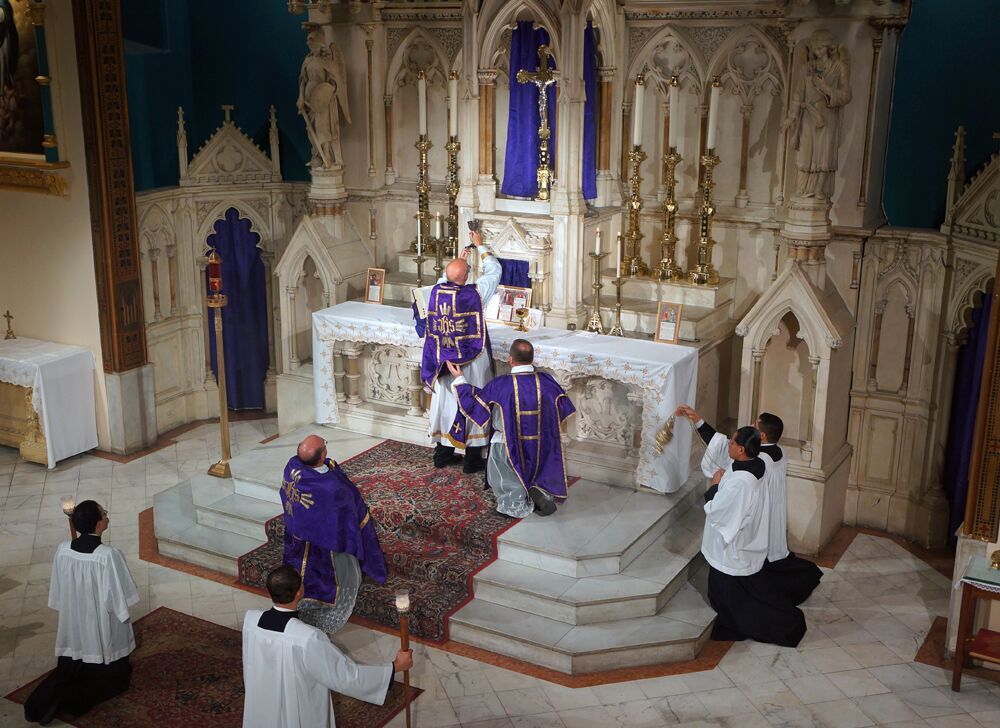
The evening started with a Solemn Mass celebrated by our Pastor Fr. Leonard Villa. Fr. Stephen Saffron was the Deacon, and Fr. Christopher Salvatori was the Subdeacon.
The purpose of the Dinner was to show gratitude for the Priests who have helped at Holy Innocents (particularly with the traditional Mass) throughout the year.

*
*

*
Holy
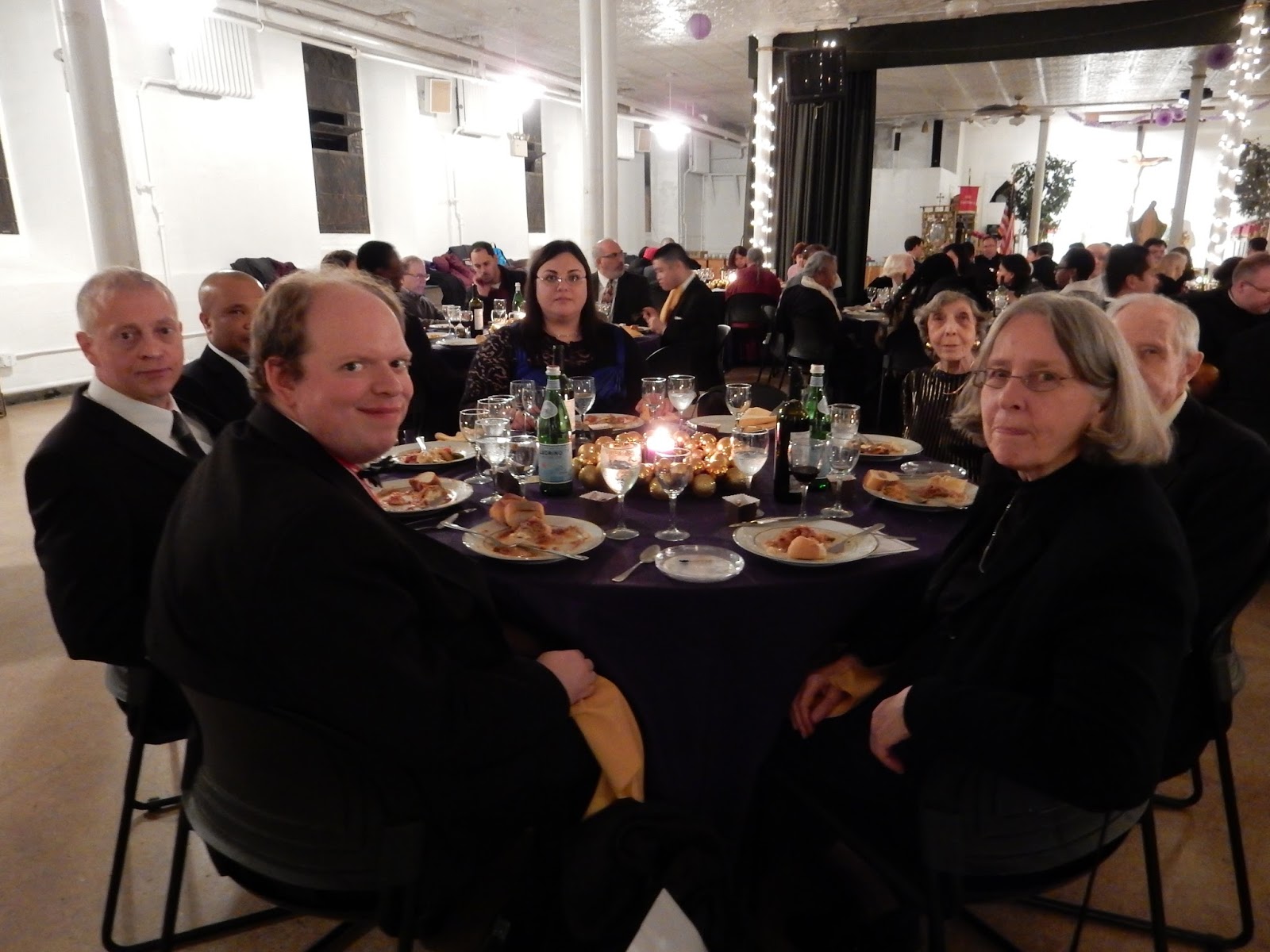
Innocents' Regina Coeli Council (#423) of the Knights of Columbus sponsored its
2nd Annual "O Antiphon" Dinner on December 17th to honor/thank the
priests who celebrate the Traditional Mass at Holy Innocents.
Tickets
for the Dinner sold out nearly a week before the Dinner. Holy Innocents' Church Hall, home of the parish's Thrift Shop,
was transformed for the blacktie Dinner.
*

*

Tables were nicely and neatly set
*

*
Among
the priests attending the dinner were Fr. Leonard Villa, Pastor of the Church
of the Holy Innocents, Canon Wulfran Lebocq, ICK, Canon Jean-Marie Moreau, ICK,
Fr. Richard Munkelt, Fr. Robert Rodriguez, Fr. Stephen Saffron, Fr Christopher
Salvatori, CAS, Fr. Marion Wierzchowski, CAS, and Fr. John Zuhlsdorf.
*
Every Priest who attended the dinner received a gift (a copy of Cardinal Sarah's excellent book God or Nothing).
*

From L to R: Canon Jean-Marie Moreau, Fr. Christopher Salvatori, and Fr. John Zuhlsdorf
*

*
The
Dinner was a fundraiser to help restore Holy Innocents' Msgr. Dineen
Monstrace. Msgr. Aloysius Dineen — who
was himself a life-long member of the Regina
Coeli Council — commissioned the Monstrance during his term as Pastor of
the Church of the Holy Innocents from 1931 - 1951.
*

*


*

*

*

*

*
After hors d'houvres, Fr. Villa blessed
the food and then many of the Priests in attendance joined Holy Innocents'
Schola singing the Magnificat with
the O Antiphon for December 17th (O
Sapientia) facing the statue of Our Lady.
*

*

*

*

*

*

*

*

*

Fr. Robert Rodriguez
*
*

*

Fr. Marian Wierzchowski
*

*

Fr. Richard Munkelt
*

*

*

Canon Wulfran Lebocq
*

Fr. Leonard Villa (Pastor of Holy Innocents) and Fr. Zuhlsdorf
*

*
*

*

*
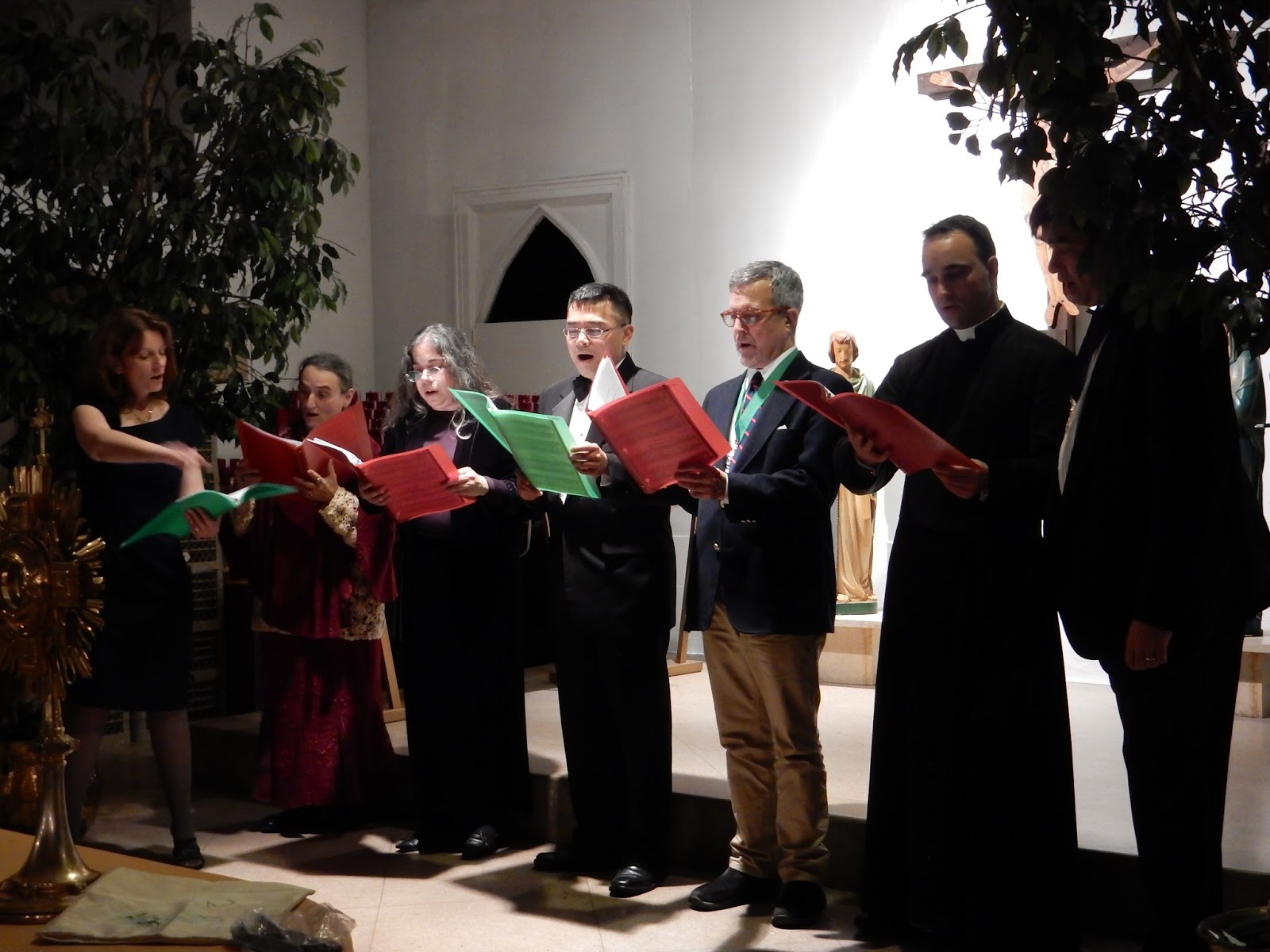
Following dessert, Holy Innocents Vox in
Rama choir sang a preview piece (Veni Emmanuel) from its concert Advent and Christmas from
Around the World (on Saturday, December 19th).
*
*

The main cake (there were two!) had the beginning of the O Antiphon for that day written on it. The cake was delicious!
*

Fr. Stephen Saffron (Chaplain of the Regina Coeli Council of the Knights of Columbus) and some of the Officers
*

*

Knights of Columbus in attendance
*******
At the end of the evening, there was a
drawing for four (4) premium tickets ($200 each) to a performance of the Radio City
Music Hall Christmas Spectacular given by an anonymous donor to support the
Dinner. Anthony Fountain and Vladimir
Quirico each won two tickets.
Subscribe to:
Posts (Atom)