Sunday, February 21, 2010


Monday, January 25, 2010
Pontifical Mass by Cardinal Egan on March 25th, 2010
 *
*
Friday, January 1, 2010
New Liturgical Ordo for 2010
by Daniele Di Sorco
This new edition is divided in two parts (volumes).

VOLUME I: PARS GENERALIS (complectens documenta, tabellas et schemata ad sacram liturgiam ordinandam, format: 14x21, 77 pages).

VOLUME II: PARS SPECIALIS (complectens directorium liturgicum pro anno Domini 2010, iuxta calendarium Ecclesiæ universæ, format: 14x21, 147 pages).
***
Letter by Msgr. Guido Pozzo

This Ordo is a complete guide for the entire year to the celebration of the traditional Mass. Written by Daniele Di Sorco, the Ordo conforms fully to the regulations of Summorum Pontificum and is an indispensable addition to all churches and chapels where Holy Mass is celebrated according to the 1962 Roman Missal. It would also make a great gift for all priests, religious and faithful who, in private or in public, recite the traditional Roman Breviary.
The Ordo has been divided into two volumes in order to make it easier to consult and to make it less expensive. In fact, the first volume, which contains the general guidelines for the celebration of Mass and the recitation of the Office, can be purchased once and for all, while the second volume, which contains the liturgical outline for the year in progress, has to be republished every year. Only for this year the two volumes are sold together.
***
The first volume has:
1) Excerpts from Summorum Pontificum.
2) The rules on fasting and abstinence.
3) The tables of precedence, occurrence and concurrence.
4) Ample indications on how to organize the various parts of the Divine Office and of the Mass depending on the liturgical day.
5) A very helpful and concise set of norms that regulate the tones of voice used for the different types of Mass (Low, Sung, Solemn).
6) An excerpt from the Instructio de Musica sacra et sacra Liturgia, which deals with active participation of the faithful at Holy Mass.
7) Tables and guidelines on the celebration of 4th Class Votive Masses.

***

The second volume has:
1) The table of movable days.
2) The complete liturgical directory for the current year according to the universal Roman calendar with precise and detailed instructions for the recitation of the Breviary and the celebration of the Mass.
The use of the Latin language makes this Ordo accessible even for those who do not have a deep knowledge of this language and allows many other Catholics of the world to use it.
The Ordo may be obtained at any bookstore (in Italy). The ISBN number of the two indivisible volumes is 978-88-8272-514-3. It may also be purchased directly from the sito della casa editrice Cantagalli.
Tuesday, November 17, 2009
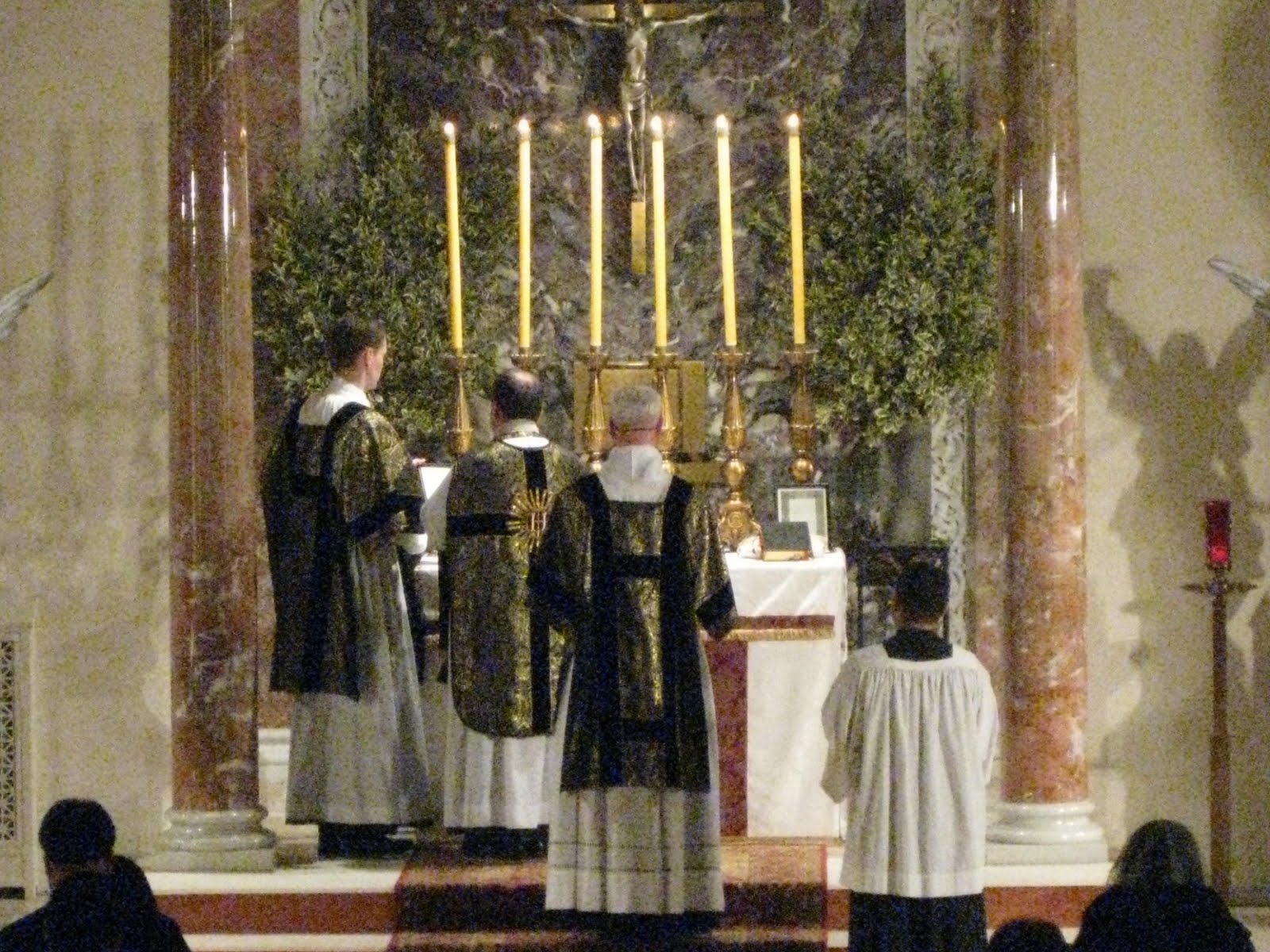
Solemn Requiem at the Church of the Guardian Angel - November 6th, 2009
 *
* *
* *
* *
* *
* *
* *
* *
* *
* *
* *
* *
* *
*
 *
* *
* *
* *
* *
* *
* *
* *
* *
* *
* *
* *
* *
* *
* *
* *
* *
* *
* *
* *
* *
*
Thursday, November 5, 2009


Tuesday, October 27, 2009
(Traditional) Pontifical Requiem Mass
 *There will be Solemn Pontifical Requiem Mass at the faldstool for All Souls' Day in New York City at the Church of the Holy Innocents (37th St. and Broadway) on Monday, November 2nd at 6:30 PM.
*The choir will sing Victoria's Requiem for six voices.
*After Mass, there will be the Rite of Absolution at the catafalque.
*This Mass will be the first Pontifical Requiem Mass in New York City since the Council. We all thought that maybe Cardinal Spellman's funeral might have been the last. But, interestingly, Cardinal Spellman's 1967 funeral was already entirely in English, the con-celebrants wore purple and the Dies Iræ Sequence was omitted. It provoked some controversy at the time.
*Tapers will be distributed during the Mass to those in the Sanctuary as well as to the congregation. This will be done with the intention to revive the custom that Stehle-Rettger (Manual of Episcopal Ceremonies) and Jeffrey Collins (The Roman Catholic Ceremonial) mention in their books on the Rubrics of the Mass:
Lighted wax candles may be held by the clergy during the Gospel, from the Sanctus to the Communion inclusively, and at the Absolution. (Manual of Episcopal Ceremonies, Vol I).
The clergy in choir may hold lighted candles during the singing of the Gospel, from the Sanctus to the Communion (both inclusive), and during the Absolution. If this is done, the acolytes will distribute these candles during the latter part of the Dies Iræ (unless the clergy already have them, as they may for at a funeral); they should light the first few and let the clergy pass the flame among themselves. The candles are to be lighted again in a timely manner for the Sanctus and then once more at the end of Mass. (The Roman Catholic Ceremonial, Vol I).
Thursday, July 30, 2009
Solemn Vespers by Bishop Rifan on June 21st, 2009
 *
* *
* *
* *
* *
* *
* *
* *
* *
* *
* *
* *
* *
* *
* *
* *
* *
* *
* *
* *
* *
* *
* *
* *
* *
* *
* *
* *
* *
* *
* *
*  *
*
 *
* *
* *
* *
* *
* *
* *
*